Essays & Research
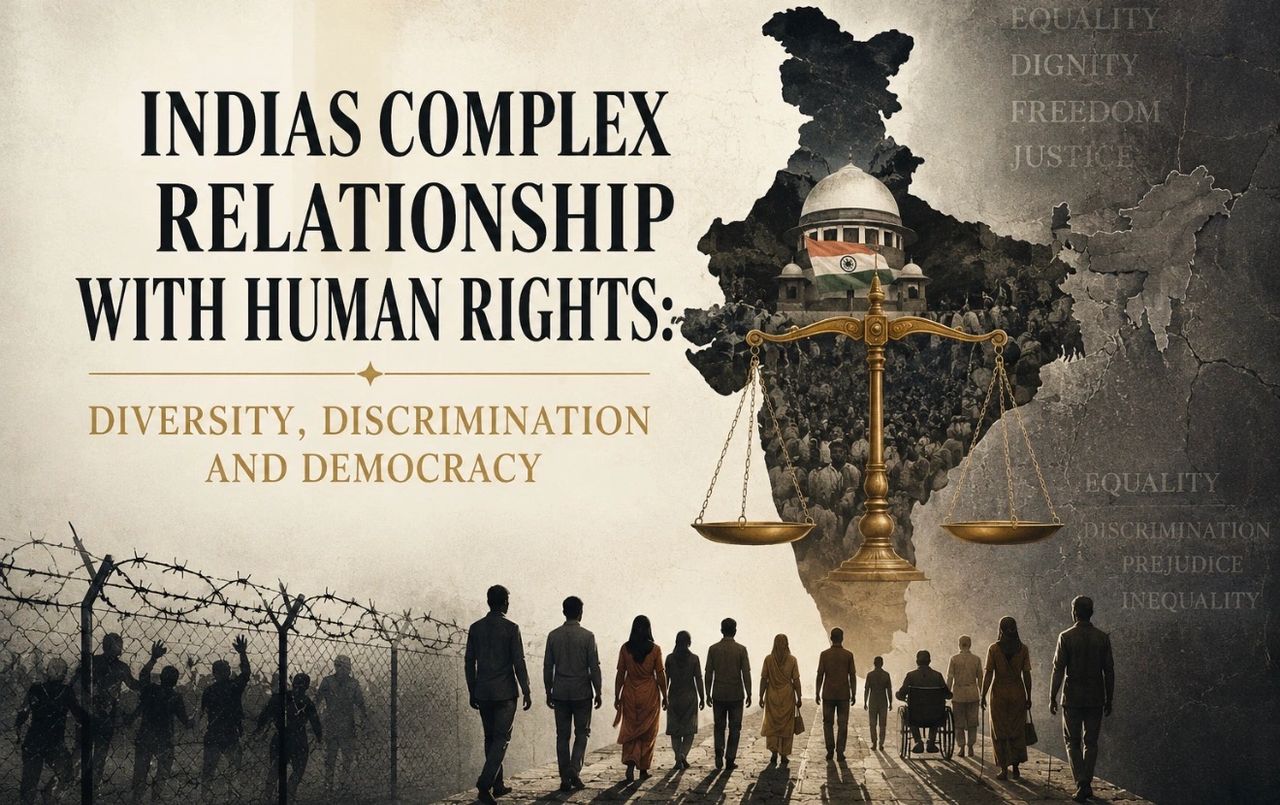
India's Complex Relationship with Human Rights
India has historically proven itself to be a diverse and pluralistic country, however, there has been a convoluted relationship between India and Human Rights. The Indian constitution was adopted in India in 1950 and carries the legal moral of protecting the equal rights and opportunities for its citizens. Religious fundamentalism has often proven to be a threat to the secularity and to the human rights of Indians.
Article 15 of the Indian Constitution and Articles 25–28 guarantee religious freedom and the right to manage religious institutions in India. Further, it is integral to note here that the Constitution of India guarantees the equal treatment of all religions, while maintaining a clear segregation between the government and the religion — meaning that there would not be any favourable treatment of any one religion over the others. Apart from the legislative, the judiciary plays an integral role in the maintaining of human rights and the retaining of freedom of religion in India.
"The State shall not discriminate against any citizen on grounds only of religion, race, caste, sex, place of birth or any of them… No citizen shall, on grounds only of religion, race, caste, sex, place of birth or any of them, be subject to any disability, liability, restriction or condition."
International NGOs and government reports often acknowledge and even highlight the diversity of India's religious and community based society and acknowledge that while its existing legislative framework is broad enough to safeguard those who are vulnerable at the intersections, it also exhibits the willingness to show accountability and correct its mistakes in favour of safeguarding human rights and promoting secularism.
Universal Periodic Review
Since it was first implemented in 2006, the United Nations Human Rights Council's Universal Periodic Review (UPR) has grown to become the primary forum for international examination of the human rights track record of each UN member state. The first Universal Periodic Review from 2008 was conducted by the United Nations Human Rights Council in order to assess the situation of human rights in each member country of the United Nations. Since India is a member of the United Nations and is a key propounder of human rights on the international arena, it participated in the process as well and was provided with many recommendations regarding the concerns raised by the UPR relating to discrimination, minority rights and access to justice, along with violence against women.
India responded to this report by responding to it with a peripheral view of how it planned to combat these issues and instead of denying its responsibility, it highlighted its commitment to human rights, democracy, and the rule of law.
The 2nd Universal Periodic Review was released in 2012 wherein India was provided with another set of recommendations, and concerns — this time they related to the rights of religious and ethnic minorities and freedom of expression. Recommendations included measures to address issues of police brutality, extrajudicial killings, and the need for police reforms and accountability mechanisms.
Following India's third review in the Universal Periodic Review (UPR) mechanism of the Human Rights Council on May 4, 2017, the Indian government acknowledged and agreed to implement nine recommendations pertaining to discrimination based on caste. The most notable recommendation was by Ireland who advised India to develop public human rights awareness programmes and take concrete steps to advance the rights of women and girls, members of religious minorities, and LGBTQ+ persons, as well as to combat caste-based discrimination.
Armed Forces Special Powers Act and Jammu & Kashmir
Amnesty International's report from 2015 highlighted the issue of human rights violations in Jammu and Kashmir and how there was an urgent need to pay attention to the obstacles to justice of human rights violations existing in both law and practice in Jammu and Kashmir because of its impunity problem. It mentioned how since the 1970s, Indian military personnel have been stationed in Jammu and Kashmir, where they are ostensibly entrusted with the protection of civilians, the maintenance of national security, and the suppression of violence perpetrated by armed groups but under the guise of security operations, members of the security force have perpetrated a number of serious abuses of human rights, many of which have been allowed to go unpunished.
The report contended that from 1990 to 2011 there were around 43,000 deaths of citizens in the state, and of these more than 21,000 were termed to be militants while the others were civilians. Despite assurances that there would be 'zero tolerance' for abuses of human rights committed by the army in 2013, more than 96% of complaints lodged against the army in Jammu and Kashmir were deemed to be 'false' or 'motivated by ulterior motives.'
According to the State Department's 2022 Country Reports on Human Rights Practices, India is a federal parliamentary democracy with primary responsibility for maintaining law and order held by states and union territories, while the central government provides policy oversight. However, India has been widely recognized by U.S. government agencies, the United Nations, and some non-governmental organizations as a site of numerous human rights abuses, including significant violations, with some attributed to agents of both state and federal governments.
Furthermore, various analyses have raised concerns about democratic backsliding in India. The Varieties of Democracies project in Sweden has classified India as an 'electoral autocracy' since 2019, and in 2023, it labeled India as 'one of the worst autocratizers in the last 10 years.' Since 2021, the U.S.-based non-profit Freedom House has reclassified India as 'Partly Free,' stating that Modi and his party are pushing India toward authoritarianism.
"due to the Indian government's promotion of Hindu nationalism, and engagement and facilitation of systematic, ongoing, and egregious violations of religious freedom."
In 2019, the Indian government revoked Article 370 of the Indian Constitution and Section 35A of its Annex, which had granted the state nominally autonomous status. This move resulted in the bifurcation of Jammu and Kashmir into two 'Union Territories,' each with reduced administrative powers. The United Nations Office of the High Commissioner for Human Rights (OHCHR) expressed concerns that these changes could undermine the rights of minorities.
Human Rights Watch's World Report 2023 criticizes both the Public Safety Act and the Armed Forces (Special Powers) Act, which it claims allow for mass detentions without charges and provide impunity to security forces, even in cases of serious human rights abuses. These developments indicate ongoing concerns about human rights and the situation in Jammu and Kashmir. In response, the New Delhi government issued a rebuttal, denying many facts stated in these reports and claiming the conclusions drawn were incorrect.
References
- "Universal Periodic Review" OHCHR. Available at: https://www.ohchr.org/en/hr-bodies/upr/highlights10-april2008pm
- "Second Right of Reply by India in Response to the Statement by Pakistan under the Agenda Item 2 during the 33rd Session of the UN Human Rights Council" Ministry of External Affairs, Government of India.
- "Universal Periodic Review — India" OHCHR. Available at: https://www.ohchr.org/en/hr-bodies/upr/in-index
- "India: 'Denied': Failures in Accountability for Human Rights Violations by Security Force Personnel in Jammu and Kashmir" Amnesty International, June 1, 2021.
- Randeep Singh Nandal, "State data refutes claim of 1 lakh killed in Kashmir" Times of India, 20 June 2011.
- US State Department Report. Available at: https://crsreports.congress.gov/product/pdf/IF/IF12198